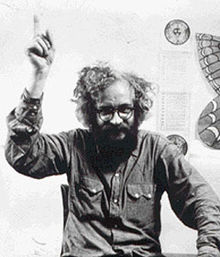
Thursday, June 21, 2012

Art Is A Three Letter Word


"I took a deep breath and slid the handle down over the end again and worked the blade loose from the table.  A curious knife, with design and purpose in it, and neither of them agreeable."-- The Little Sister, Raymond Chandler, 1949


Recently, I began re-reading Raymond Chandler's The Little Sister.  The novel is one of several about a perpetually 38 year old private investigator named Philip Marlowe.  Mr Chandler served in World War I and became the director of a number of independent oil companies based in southern California.  Along came The Great Depression and the end of a career in the petroleum business for Mr Chandler.  He turned to writing lurid tales for the pulps and critically acclaimed books...


Paleolithic men decorated the walls of Lascaux Cave in south-
western France with hundreds of images over 20,000 years ago.
Some scholars believe the paintings were a part of magic rituals
meant to insure a successful hunt.  Others argue these ancient
artists simply recorded what they saw in the world around them.
Chandler's book "got me to thinkin" (as they say here in West Texas) about beauty and why something is beautiful and why something is not. Philip Marlowe moves through a morally ambiguous world peopled with crooked cops and raving-mad heiresses who pose for pornographic pictures and then kill bootlegger boyfriends... 

But Marlowe never fails to notice beauty, deadly or not.  The Little Sister ends with the former policeman staring at the body of Miss Dolores Gonzales.  A knife protrudes from her chest.  It is silver, exquisitely crafted.  The knife's handle is the skillfully done and fully nude representation of a most beautiful woman...

Beauty, in the case of The Little Sister,
was a deadly dagger wielded by a
disgraced doctor married to a woman
who dallied with gangsters.
Art and Beauty, the Sage of the well-known village Cliché informs us, are both in the eye of the beholder...

There is unintentional wisdom in this truism which suggests a viewer and something to be viewed.  Martin Buber, a philosopher of profound insight, would say there is an I - It relationship between me and the canvas or sculpture I call art.  Buber was not primarily concerned with aesthetics.  He wrestled with the way humans interact with God.  To him, God is ever-present in our consciousness and manifests Himself or Herself through our culture-- art, music, literature, and so forth...


It is one thing to say there is a thing called Art that can be appreciated by my eye or which is a trace of the Divine.  But defining what it is?  Ah, another thing entirely.  Lady Luck seems to want to help us because the dictionary (Merriam Webster's Collegiate, Tenth Edition) tells us "art" involves the conscious use of skill and creative imagination in the production of aesthetic objects...


Aesthetics, we learn when we flip pages in MWC, 10 ed., has to do with the nature of beauty and how our mind (by way of our senses) defines whether or not something is attractive.  Great thinkers have wrestled with "beauty" for many centuries.  Plato theorized beautiful objects incorporated proper proportions, harmony, and unity in their parts.  His pupil Aristotle echoed him to a certain extent: order, symmetry, and being clearly defined were qualities he considered essential...

Ancient Greeks decorated everyday objects such as
amphoras with scenes taken from their rich religious
history.  Here, Zeus prepares to wield his deadly
thunderbolt. 

Greek art from the Classical (and Hellenistic) Period catches the viewer's eye and refuses to let go.  Its makers adorn gems and coins with striking, realistic portraits and figure studies.  Cups and vases celebrate fantastic stories of gods and heroes like Theseus battling the minotaur.  Perhaps most striking are sculptures of the same gods, heroes, and ordinary men:  almost perfect examples of youthful and mature physical perfection.  Yet the faces of these statues hint at pensiveness-- the contemplation of deeper realities of soul, life, and creation...

But, then again, the Greeks themselves were like that... 

They recognized man's basic nature incorporated the cool rational thought of Apollo and the madness of Dionysus...

The Artemisium Zeus, dating to around the 4th
century BCE, depicts the King of Gods and Men
as a virile, perfectly proportioned mature male.
Their gods were one big happy dysfunctional family, each terribly protective of their sphere of influence and suspicious of the fidelity of their mates.  Zeus (like Egypt's Osiris) married his sister Hera.  He had a wandering eye, begetting Perseus by one mortal woman, Hercules by another, dozens more by other the attractive daughters of kings and farmers...

Perhaps this lack of attention from her spouse encouraged Hera to participate in a contest with ultimately disastrous results for the town of Troy.  Zeus had hosted a banquet honoring the marriage of Peleus, a mortal man, and Thetis, an immortal sea goddess.  Weddings being the frenzied affairs that they are, someone forgot to invite Eris to the festivities.  This was a mistake since Eris was the goddess of discord and trouble.  She attended the wedding anyway, tossing a golden apple at the revelers.  It had an engraved inscription: For the fairest one...


Naturally, there were three fairest of all present-- each a goddess of major importance.  Hera, Athena, and Aphrodite all claimed the apple was meant for them.  Zeus wisely declined their request to decide who was loveliest lady in the room... 

French illustrator Georges Barbier places the
Judgement of Paris in a contemporary setting
as the young prince chooses the loveliest of
models at a fashion show in this 1915 Art Deco
work.

It was in Zeus' interest to do so.  One woman was his wife and the other two were daughters (depending on which myth about Aphrodite's birth one choses to believe) who both knew they were Daddy's favorite child.  Zeus remembered a recent bull-judging contest in which a Trojan prince named Paris had decided wisely and with considerable courage against the God of War.  He suggested his divinely lovely trio ask Paris to give the golden apple to the loveliest...


Poor Paris had been set up for disaster.  Zeus undoubtedly thought he was doing the lad a favor.  The three most beautiful females in the universe suddenly appear before you stark naked.  "Take your time.  Study our bare selves", they say, "then tell one of us she's a teeny-weenie smidgen prettier than the other two."  Such a wonderful deal would probably cause friction even if the three ladies were mortal.  Give each woman an almost limitless power to create misery for a guy who even dares to think another gal looks better naked...  


For a very long time, the Greeks ignored the nakedness of woman in their art.  Male nudity did not suffer the same fate-- Zeus, father of gods and men, is shown bearded and naked as he prepares to hurl his thunderbolt.  Hermes, the messenger of Mount Olympus, stands idly skyclad as the infant Dionysus demands affection.  Apollo gladly and rather proudly advertises why he was considered the incarnation of masculine virility...

The courtesan Phryne defends herself against the
charge that she falsely claimed to be as beautiful
as Aphrodite in Albert Wein's 1949 sculpture.

This inattention to woman ended with Praxiteles who lived in the 4th century BCE.  He was the first, a large number of scholars say, to sculpt the nude female form into a life-size sculpture.  Praxiteles' model for the statue was a courtesan named Phryne who was once accused of blasphemy after she stepped naked into the sea at the festival of Poseidon at the town of Eleusis.  The painter Apelles was so awe-struck that he commemorated the moment in a painting he called "Aphrodite Rising From The Sea"...

Bernini's Rape of Proserpina tells the story
of Persephone (known to the Romans as
Proserpina).  Her abduction by the god of the
underworld became the basis of an ancient
cult centering on the Mystery of death and
resurrection in nature.
His (and her) political enemies seized the moment and charged her with making false claims of divinity.  Much evidence was entered against her and but little to support the extremely wealthy courtesan.  A guilty verdict seemed assured.  The story goes, as the judges deliberated, Phryne stood and wordlessly loosened her robe.  She stood naked and there were none among her accusers who could deny that Aphrodite herself had chosen to incarnate herself into mortal form...

[The historian Polybius later wrote Aphrodite became quite angry when she first saw the sculpture of Phryne, furiously demanding to know when Praxiteles had the good fortune to see the most beautiful of goddesses naked.]     

Medieval men celebrated the majesty and beauty of
Creation with hewn stone cathedrals, such as the one
at Chartres, where the sacred geometry of God's
creation dwarfs mortal worshippers.
Medieval men studied the classical thinkers but did not share ancient Greece's urge to celebrate life through human eyes and contemplate its meaning from that standpoint.  Their focus was rebuilding lasting political and social order after the collapse of Rome so the world would be ready for the return of Christ and his eternal kingdom.  True, Saint Bonaventure did retrace Art to Theology, seeing an artisan's skills as a gift given him by God so God may be known to mankind.  And Thomas Aquinas' restless mind demanded more of beauty than merely being evidence of the Divine... 

For this scholarly saint, Umberto Eco has noted, beauty required measure, nature, and order.  Measure meant the artist used proper materials for his work.  Nature demanded proper forms be used.  Order had to do with a fitting inclination in the artist and morally correct purpose for his work...
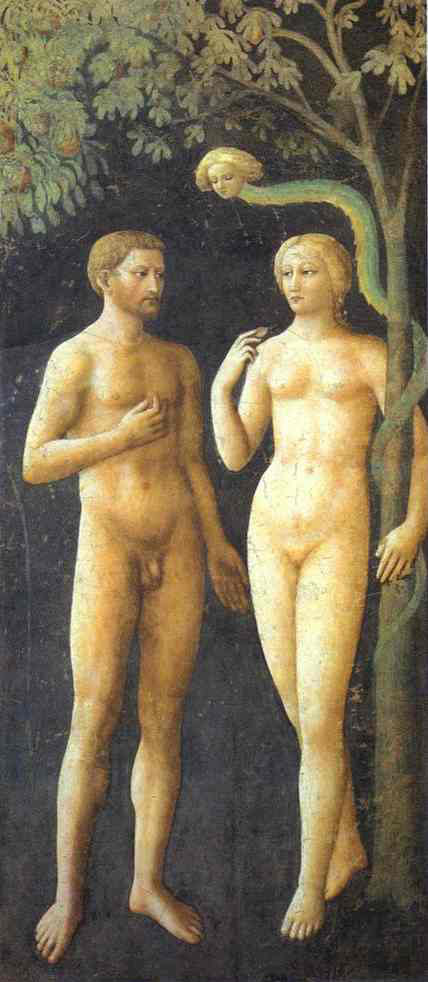
Renaissance artists such as
Masolino used Biblical tales
such as the story of Adam and
Eve to explore human forms
in a context acceptable to
powerful religious leaders.
This 1425 work graces the
Brancacci Chapel of Florence.
But, by and large, Saint Bernard of Clairvaux, patron of the Knights Templar, seems to have summarized Middle Ages' thinking about beauty.  He saw it as a double-edged sword akin to Adam's wife.  Could there be a thing lovelier than Eve fashioned by the very hand of God?  And what could be deadlier than beauty which leads Man to eat fruits of forbidden knowledge?  It's best a spiritual man avoid thinking about temptation and its handmaidens lest his soul stray down the wrong path.  And the best way to do what was best was to celebrate and honor the glory of God...

The Greek love of symmetry and order came from observations of nature.  Every man, animal, or plant has two roughly identical halves... a right eye is balanced by a left eye, a tree's branches vary somewhat in shape and number from one side to another but on the whole they spring from the trunk in basically equal fashion.  (Monsters such as the Cyclops were not balanced but there were heroes available to do them in and restore order.)  Greek thinkers vigorously studied the natural world to learn the natural order of things so men could live in harmony with creation...

Chaim Soutine's Chartres Cathedral
shows a place where the rigid stone
structure becomes a fluid interface
with the supernatural.

Medieval men saw the same order and symmetry in creation.  But their concerns were different than Greek concerns.  For the ancient Greeks, the underworld was a vaguely defined place.  Not so in the new Christian world: an eternal Heaven or Hell awaited the soul which had to find salvation in a creation corrupted by man's disobedience to God.  Children of the Church acknowledged beauty and order of the universe with great stone cathedrals meant to last centuries.  Statues in these massive structures did not celebrate the folly of Lascivious Man or Vain Woman: they commemorated the piety of Prophet and Martyr instead...

[In the odd ways of history, classical religion helped pave the way for the Church.  Late Greek spirituality revolved heavily around the Mysteries of Orpheus and Eleusis which touch on the theme of Beauty Lost-- the musician who travels to Hades to reclaim his lovely Eurydice and loses her again, the beautiful Persephone who is snatched from the world of light and joy to become Queen of the Underworld.  These and similar cults grappled with the questions of death, resurrection, and the fate of the soul.  They were widespread throughout the Roman Empire.  The story of Jesus' victory over the grave touched a chord in a tailor-made audience waiting to hear it throughout the non-Jewish world of Europe and the Near East.]  
Mystery, beauty, and danger intertwine in Noir genre work like
Moonlight Invitation.  These long-linked themes are likely to
continue to inspire artists as long as there are artists to ponder
mystery, beauty, and danger.

We ordinary mortals sometimes speculate about which historical figures we would like to meet.  Some of us think conversation with Albert Einstein or Isaac Newton would be enlightening.  I suspect, given the opportunity to speak to souls of previous times, our medieval churchmen would be like many people I know and leap at a chance to speak with Jesus or Moses or Isaiah.  Me?  I think I should prefer a chat with Phryne over wine and bread at a quiet sidewalk cafe in Paris on a lovely April day...


But, should three goddesses fair suddenly appear naked before me and demand that I choose the fairest of all, I think I would take a knife and cut the Golden Apple they give me in three identical portions and beg for mercy, crying out the task cannot be done by a mere man since each of them becomes a thousand times lovelier with each passing second...


The story of Orpheus and Eurydice, the basis of
another Greek Mystery religion, has been told in
dance, film, sculpture, and painting.  Choreographer
Sarah Ruhl's ballet, Eurydice, is but one retelling.

NEWS CORRAL:

The fate of the dune lizard rests in the hands of companies whose profits are enhanced by drilling for oil and gas in its habitat.


LRNARTS MARKETPLACE


Artwork by Louis R Nugent now available:  For fine art prints and greeting cards, visit:

Featured this week: Vintage Nude In An Even More Vintage Building


Fine Arts America now features West Texas painting, drawings, and photographs by Karen Slagle of Amarillo, Texas,  Linda Cox of Graham, Texas, Suzanne Girard Theis of Houston, Texas, Judi Bagwell of Greenwell Springs, Louisiana, Karen Boudreaux of Houston, Texas, Joe JAKE Pratt of Kerrville, Texas, David Pike of Lubbock, Texas, Ken Brown Pioneer of Sand Springs, Oklahoma, and Louis R Nugent of San Angelo, Texas at:


CREDITS

Note: All photographs and other images for this essay were located through Google Images or Wikipedia, without authoritative source or ownership information except as noted: Phryne Before The Judges by Albert Wein from Ossining.org; Interior of Chartres Cathedral from artappreciationmf.wiki.uml.edu; Chartres Cathedral by Chaim Soutine from wikipaintings.org; Zeus on Greek Amphora from theoi.com; the Rape of Proserpina by Gian Lorenzo Bernini from mlahanas.de; Chris Smith and Rachel Story as Orpheus and Eurydice from Sarah Ruhl's ballet Eurydice from gailsez.org; Ballantine Books 1971 edition cover art for Raymond Chandler's The Little Sister by Tom Adams; Moonlight Invitation by Louis R Nugent from louis-nugent.artistwebsites.com

Thursday, June 14, 2012

Journey To The Desert's Edge, Part 6

 Note: this is the sixth in a series of occasionally appearing entries focusing on deserts in general and the drylands of West Texas in particular


Location, location, location, says the Realtor and the Business Marketing Advisor.  One is unlikely to encounter deserts in Delaware.   Or France or Iowa or Malaysia.  There is, Good Reader, a recipe for making them... 
The first ingredient is location...

Desert landscapes are not always sandy.  The Chihuahuan Desert
is dotted with pockets of grassy shrublands from southeastern
Arizona (shown here) to the western Concho Valley of southwest
Texas

Deserts, at least those we call Hot Deserts, generally form between 20 degrees and 30 degrees latitude.  Atmospheric circulation patterns such as the Hadley Cell play key roles in creating conditions needed to bake land dry.  Heated by the sun at the equator, air rises and expands and cools.  Rain falls and lush tropical rainforests are created... 

The air continues to rise, eventually coming down in the subtropics before it returns to the equator.  As it descends, physics dictates air becomes compressed and warm.  Its relative humidity plummets.  Deserts form below these descending and dry air masses...

Chihuahuan Desert: Chisos Mountains in the Big Bend of Texas
A person would (reasonably) expect all land under them should be desert country.  But, obviously, this is not the case.  We ask ourselves: why, at the same latitude, is wet and rainy Louisiana not an arid wasteland like West Texas?  The answer: location, location, location... 

The tendency to dryness is interrupted in certain places, especially on the eastern side of continents.  Winds loaded and heavy with moisture from the ocean blows onshore.  Rain falls.  As the distance from the coast increases, the amount of moisture available to generate precipitation decreases.  Mountain ranges create "rain shadows" blocking westward movement of clouds that already have very little moisture in them.  In the United States, the hottest and driest desert country lies between the Rocky Mountains and the coastal ranges near the Pacific...
A tendency to dryness thanks to unpredictable rainfall is a second and, perhaps, most important ingredient in our recipe...   

The basic nature of desert precipitation is to be low, erratic, and often violent.  It is also generally ineffective since the potential for water loss through evapotranspiration (pET) significantly exceeds actual rain totals in deserts.  (Readers may recall, from a previous essay in this series, that studies by H C Trumble show an area is "water-deficient," i.e, a desert, when potential for water loss is three times or greater than precipitation)  In a statistically average year, Tom Green County in Southwest Texas receives 18.2 inches of precipitation with a pET of nearly 72 inches.  Few are statistically average years in deserts: a worldwide correlation exists between total rainfall and its predictability.  The lower the annual rainfall for a location, the higher the year-to-year variation in amounts that actually occur...  

Sonoran Desert: The giant saguaro cactus symbolizes
the Arizona drylands

An extremely arid place like Yuma, Arizona, might average 3.39 inches of precipitation yearly.  The actual totals for a given climate cycle there, however, could be as low as 0.28 inches and as high as 11.42 inches...

Back in Texas, San Angelo fares better than Yuma.  National Weather Service numbers give it annual average rains of 21.25 inches over the past three and a half decades.  Nevertheless, precipitation is unpredictable: actual totals of under 10 inches and more than 30 inches have been recorded.  Yearly rains of 20.25 inches to 22.25 inches, one inch plus or minus the average figure, fell only four times in the last thirty-five years...


The range of actual yearly rainfall totals in semi-arid deserts are not always as variable as those in very, very dry places.  West Texas is dry largely due to distance from the warm waters of the Gulf of Mexico.  Seasonal storms provide much of the annual rain in this dry country.  Cold fronts and stationary hot air masses collide, triggering violent and sudden storms in spring and autumn... 


But even these seasonal rains cannot be predicted accurately.  For San Angelo, we see data showing September is a "wet" month that averages 2.95 inches of rain.  True totals range from less than 0.01 inches to 11.0 inches during the ninth month of the year...

Mojave Desert:  North America's smallest desert is known for
Joshua Tree yuccas and for being one of the hottest and driest
places on the continent

North American deserts have "rainy seasons" during which most of a year's precipitation usually occurs.  The Mojave and Great Basin see a "winter pattern" when Pacific Ocean storms move eastward and inland.  The resulting precipitation is low intensity, may last for several days, and often cover large areas.  From spring through autumn, storm cells from the Gulf of Mexico track to west and northwest to create a "summer pattern" in the Chihuahuan.  These rains are likely to be convective thunderstorms-- intense, localized, and brief.  A mixed pattern of summer and winter rain characterizes the Sonoran since it is centered between Pacific and Gulf storm systems... 


Relative humidity tends to be below 50% in the North American deserts.  This adds one more ingredient in our recipe for making a desert.  Since water in air molecules acts to trap infrared radiation from both sun and earth, low relative humidity guarantees a large percentage of possible solar radiation reaches the ground during daylight hours and that much of the accumulated surface heat radiates back into the atmosphere after dark.  Low relative humidity also aggravates aridity by limiting cloud formation, increasing the amount of sunlight that reaches the ground...
Desert Grasslands along US Highway 87 north of San Angelo, Tx

Depending on relative humidity levels, maximum and minimum temperatures can vary from twenty-five degrees or less to fifty degrees or more during a twenty-four hour period.  (This variation does not always affect desert cities due to the urban heat island effect.)  Low relative humidity also translates into extremes between annual maximum high and low temperatures.  Annual mean temperatures in deserts range from the mid-sixties to the mid-seventies degrees Fahrenheit...

Temperature, in conjunction with air movement and precipitation, plays a major role in determining evapotranspiration rates.  High temperatures accelerate the process and low temperatures retard it. Summer heat, sustained for months at a time, rapidly bakes already dry land.  We have yet another recipe ingredient...

Great Basin Desert: Mile after mile of sagebrush dots the dry
country of Nevada and Utah
 
Heat and aridity lead to higher percentages of bare soil (areas lacking vegetation or other ground cover) in our desert since plants become widely spaced due to lack of moisture. 


Lack of plant life results in soils low in humus, those organic components formed from decomposition of plant or animal matter.  Desert soils are, therefore, often light colored at the surface and low in organic matter.  They have developed in areas where limited precipitation is insufficient to leach salts and other chemicals from the soil.  These various minerals accumulate in the subsoil to form the hard layers often referred to as caliche in the southwest...
Arches National Park near Moab, Utah

This combination of poor soil and bare ground can be added as two more ingredients for our recipe.  Perhaps we can best describe them as flavoring: not all desert locales are characterized by aridisols and mile after mile without discernible vegetation...    

Arid region soils are described by those who study their ability to sustain vegetation as immature, weakly developed in terms of soil profile, and alkaline.  Desert soils do vary: they include sands, sandy or gravelly loams, shallow stony soils, alluvium, and scree-derived deposits...

Wind, too, is a major ingredient in creating a desert.  Those of us who live in the dry country think of it as a constant... rarely stopping for more than a few minutes, always drying the land, eroding soil and rock to create ravines and mesas and fantastically shaped stone formations...

It may be that one or two readers recall my comments about the Irrigation Technology Center associated with Texas A&M University in an earlier installment in this series.  A few days ago, I revisited the Center's website to pull up its data for San Angelo.  The non-archived information covers the period from May 1, 1998 to June 26, 2012, some 3980 days... 

Bison herd at San Angelo State Park in Texas


During these many years, 183.55 inches of rain fell on the Concho Valley less than ten miles north of San Angelo.  Potential water loss via evapotranspiration was a tad higher-- 745.24 inches.  Daily numbers included: minimum relative humidity of 36 percent and winds of about 7mph.  Solar radiation, on a statistician's day, averaged 18.01 megajoules per square meter... 

Life in each of our four major North American deserts is more complicated and present than most people believe.  Variations developed as regional responses to the common theme of aridity can be used to distinguish one desert from one another.  At the same time, however, plants and animals in every desert share common patterns as universal responses to challenges posed by dryness, heat, wind, and poor soil quality common to arid and semi-arid deserts...

The Twin Buttes on the western side of San Angelo silently
warn travelers they have entered the harsh and lovely drylands
of Southwest Texas


NEWS CORRAL:


The Toledo (Ohio) Blade offers some brief but well-considered thoughts about the reduction in forces which will accompany military drawdowns as US soldiers depart Afghanistan and Iraq and the nation moves toward a pre-9/11 strength.


Pat Magee of Corpus Christi believes oceans and surfing belong to the world.  The former champion wave-rider opened a free-to-the-public museum where one can see the first surfboard made in Texas. 


LRNARTS MARKETPLACE


Artwork by Louis R Nugent now available:  For fine art prints and greeting cards, visit:


Fine Arts America now features West Texas painting, drawings, and photographs by Karen Boudreaux of Houston, Texas, Ken Brown Pioneer of Sand Springs, Oklahoma, Joe JAKE Pratt of Kerrville, Texas, David Pike of Lubbock, Texas, Judi Bagwell of Greenwell Springs, Louisiana, Suzanne Guirard Theis of Houston, Texas, Linda Cox of Graham, Texas, and Louis R Nugent of San Angelo, Texas at: http://fineartamerica.com/groups/west-texas.html?tab=overview

CREDITS

Note: All photographs for this essay were located through Google Images or Wikipedia, without authoritative source or ownership information except as noted: Chihuahuan Desert: Chisos Mountains at Big Bend from Brittanica.com; Joshua Trees in Mojave Desert from LonelyPlanet.com; Great Basin Desert Sagebrush from Chihuahuan Desert Nature Center; Arches National Park from USParks.com; Twin Buttes, oil on canvas, by Dwight Holmes from San Angelo Museum of Fine Arts; Desert Shrublands from cas.vanderbilt.edu; Bison Herd at San Angelo State Park from Texas Parks and Wildlife  

Thursday, June 7, 2012

Blue Dogs and Rocky Roads


"God bless your children, I'll take care of your wife..." Stackalee, Frank Hutchinson, Okeh Records No. 45106, Anthology Of American Folk Music, edited by Harry Smith


Bearded and wild-haired and twisted by rickets, he was a short man.  He planned to initiate a magical transformation of the world.  He would do this by using eighty-four recordings,  precisely and meticulously arranged by himself as editor of a musical potpourri.  These songs would generate a specific sequence of tones which altered consciousness...  


Each of the songs that would be included in the Anthology of American Folk Music was already fairly old by recording industry standards when Harry Smith had a vague notion, circa 1940, to start collecting  scratchy 78s that captured sounds from a rural America which even then existed only in stories told by old people who yammered about those good old days before indoor plumbing and electricity.  He was seventeen years old and living not far from Seattle in South Bellingham in the lovely state of Washington... 

Harry Smith, circa 1965


Nearly thirty years later, he told interviewer John Cohen how he got into the business of creating aural alchemies, saying a recording by a Mississippi bluesman named Tommy McClennan had "somehow gotten into this town by mistake"...


It is probably destiny this music from the Mississippi Delta found its way into young Mr Smith's hands.  Harry, after all, was likely the only lad in that specific part of the Pacific Northwest whose mother claimed to be Anastasia, last of the Romanovs, this despite the fact that her own mother had been a school teacher in Alaska... 


Or the only one trying to decide if his father was the infamous English Alistair Crowley, practitioner extraordinaire of the Dark Arts, or that fishing cannery night watchman who lived with mom.  He may have been the only young white man in the Pacific Northwest who wanted to be a Native American shaman while he struggled with his own homosexuality.  As Harry dealt with such personal dilemmas, he began to gather paper airplanes made by others.  This odd hobby became the largest privately held collection of its kind ever assembled and, decades later, found its way to the National Air and Space Museum... 

Tommy McClennan


Whatever led Harry Smith to find McClennan's record led him to a Salvation Army Thrift Shop in Seattle.  There, he discovered Uncle Dave Macon singing "Fox and Hounds" for an audience very different than Tommy McClennan's but somehow the same...


Smith was awestruck by what heard in these old white hillbilly and black sharecropper blues.  He scoured the countryside for more music that sounded totally different from anything on the radio playlists in the early 1940s.  World War II came along.  And that meant warehouses had to be cleared out to make way for military supplies.  In turn, this put many long-forgotten 78s appeared on record store clearance racks for a fraction of the original price.  Harry added hundreds of titles to his collection... 


He was now a student (for five semesters between 1943 and 1944) at the University of Washington.  Many of his professors saw the young anthropology undergrad as a semi-peer.  This high esteem indirectly resulted from his delusional mother's job teaching school on the Lummi reservation.  As a boy, Harry spent as much time as possible with these Native Peoples whose ancestors gathered berries and reef-fished salmon.  One of the earliest photographs of Smith shows him, at age 15, tape-recording a Lummi ceremony.  He learned the language, customs, and religion of this coastal Salish tribe and wanted to be a shaman...

Members of the Lummi Nation, circa 1915


During his year or so in college, Smith traveled to San Francisco for the first time.  He attended a Woody Guthrie concert.  And he fell in with some bohemian painters and poets during his visit to Baghdad by the Bay.  They introduced him to a world of ideas concepts he hadn't stumbled across in Washington State.  Herbal experimentation taught him why jazz musicians were said to favor marijuana...


San Francisco proved a turning point.  He returned to school so he could leave it and return to the Bay Area.  He began to toy around with filmmaking, using combinations of stop-motion and hand-painting techniques of his own devising.  San Fran's Museum of Modern Art showed his work.  The strange little man moved comfortably in an esoteric world of California's avant-garde cinema... 

Artwork by Harry Smith: Algo Bueno, circa 1951


He caught the eye of New York museum director Hilla Rebay who was impressed by his canvas work.  She arranged for him to receive a Guggenheim grant in 1950.  Smith, not one for sedentary lifestyles, packed his bags and moved to the Big Apple where he became friends with jazzman Dizzy Gillespie (known for his bent trumpet) and beat poet Allen Ginsberg (known for poems like Howl and Kaddish)...

Whenever he worked, be it with paint or celluloid, Smith immersed himself in music, gradually seeing correspondences between color and sound, sound and movement...


Mystical thinking came naturally to Harry Smith.  His parents were Theosophists of a pantheistical variety.  Some families talk about the work day or sports or news at the dinner table.  The Smiths chatted about universal truths contained within all religions but obscured by dogma.  One might expect this of them.  Harry's paternal grandfather helped form an offshoot of mainstream Freemasonry.  The group saw itself as the new Knights Templars, despite a lack of Saracens to be fought or Grails to be sought in the farm country of turn-of-the-century Iowa.  Gramps also claimed to have been one of Ulysses S Grant's key aides during the Civil War...

Harry Smith's grandmother once managed a school in Alaska
which received funding from the Russian government.  This fact
led Smith's mother to believe she herself was actually the Grand
Duchess Anastasia, rightful heiress to the throne of "All the
Russias."


In the early 1950s, Smith became acquainted with Moses Asch, founder of Folkways Records and son of novelist Sholem Asch, Yiddish language writer.  Asch was born in Poland like his father.  At eight, Moses was living in Brooklyn, dreaming about Robin Hood and Jesse James.  He was also developing a strong distrust of local police who fired live rounds to scare neighborhood kids...

Moe Asch in his office


The Great Depression found him hammering equipment and storage shelves for radio stations.  Asch, like Harry Smith, fanatically collected blues and mountain music.  The next step was to create his own independent record label and showcase work by Josh White, Leadbelly, Pete Seeger, Woody Guthrie, and other artists not quite at home in corporate environments.  His friendship and support of these singers soon made him a leading figure in the political Old Left of American politics...

Asch suggested Harry compile an anthology of roots and blues music to be issued on the Folkways label...


Smith did just that.  At this point, his interest in old music dovetailed perfectly with his occult inclinations.  He had already formulated a theory about the link between sound and color, aural and visual stimuli.  A voracious reader, Harry Smith studied the works, theories, and lives of the English alchemists Robert Fludd and John Dee.  Particularly influential was Fludd's concept of a "celestial monochord," a stringed instrument meant to link musical intervals to the astronomer Ptolemy's earth-centered theory of the Universe...

In 1618, alchemist Robert Fludd linked Ptolemy's vision of the
universe with the musical intervals of an instrument known as a
monochord.  Harry Smith was heavily influenced by Fludd's ideas
and featured the "celestial monochord" on the cover of the first
edition of the Anthology in 1952.


The Anthology, Smith realized, offered a perfect opportunity to choose a sequence of tones that would initiate a change of consciousness in listeners and impel them toward working for social change.  He further decided the music that could do this had been recorded between the years 1927 and 1932.   

The cover of a re-issued edition of the "Anthology" features a
17th Century alchemist's drawing 


To those hearing the anthology for the first time, the music is not a collection of old tunes... 


It is a rollercoaster rattling and clanking down Appalachian mountain hollows, taking jackknife turns past Cajun dancehalls, zipping in and through broken windows in shantytowns on the wrong side of the tracks... 


Now it becomes a mystical lizard and a stolen locomotive, whooping and hollering.  It shouts glory, glory, hallelujah and races the Angel of Death.  Somewhere, it becomes a cotton picking ghost.  Next it transforms itself into a lost cowboy on desert plains.  Lo and behold!  Then it morphs into a steamship on its way to meet an iceberg in the North Atlantic... 

Turning back into a train, it pulls into Spencer right on time so the conductor can drop Parson Brown off at Bootleg Sam's ginhouse.  And then...

It's a rollercoaster again...

Rural West Virginia coal miner Frank Hutchison
crossed racial musical lines with his version of the
story of the notorious black gambler Stagger Lee
Only a fool would try to accurately summarize the eighty four songs on the Anthology.  It opens with coal miner Dick Justice singing about the murder of Henry Lee by a woman who schemes to kill a talking bird who witnessed her perfidy.  Later, we meet Old Dog Blue, remembered by Mississippi medicine show performer Jim Jackson.  Cold hearted Stagger Lee slays Billy de Lyon over a John B Stetson hat.  Blind Lemon Jefferson asks but one kind of favor from us: that his grave be kept clean.  A husband and wife shake tambourines and whoop out the fate of the Titanic.  Outlaws confess their crimes on the steps of the gallows...

Anthology of poems by Smith friend Allen
Ginsberg


Completed, published, and distributed, the Anthology of American Folk Music did not set sales records.  Shop owners tended to put the three volume, six LP set on dusty back shelves.  Where it languished until a young Bob Dylan or Joan Baez or Dave von Ronk happened on it by complete accident...


Once heard, the Anthology had a definite effect on young folkies.  Pleasant harmonies and antiseptic lyrics about murderers like Tom Dooley as sung the clean-cut Kingston Trio just wouldn't cut it anymore.  Even harder edged stuff by the Almanac Singers, the Weavers, and other devout Old Lefters had nothing to say to awakened souls ignited by Smith's ditties collection.  It literally became a musical Bible for restless folk looking to end war, racism and the inequities of capitalism...


Unless a person is familiar with the history of American popular music, particularly its folk movements, it is impossible to comprehend the impact of the Anthology on its audience.   One listener-- Peter Stampfel of the Holy Modal Rounders-- exulted that the Anthology was "the Touchstone, the Grail, The Real Deal, The Nitty Gritty, Ground Zero," adding if God were a DJ, He'd be Harry Smith...


A Harry Smith friend: Jazz trumpeter
extraordinaire Dizzy Gillespie


Dave von Ronk who recorded an iconic version of "The House of the Rising Sun" spoke at Smith's memorial in 1992:  "I didn't know Harry very well.  I made it a point to avoid him unless I was drunk... But I am here to acknowledge a debt of honor that I, and my whole generation, owe to Harry because of that anthology, which was the Bible for hundreds of us, or more.  Without (it), a whole of things never would have happened in this country musically"...


Another prominent 60s folkie, Eric von Schmidt, described the Anthology: "This music sounded like it came right out of the ground.  Songs like the clods of rich dark earth, fecund, timeless"...
Harry Smith sometimes suspected English magician Alistair Crowley
was his father.  A recent biographer has opined the so-called
"Wickedest Man in the World" (believed by his own mother to be the
Great Beast foretold in Revelations) was, in fact, a British secret agent
who used his bizarre antics to disguise his service to England.

Allen Ginsberg also remembered his panhandling pal: "The amazing thing was that in the last year of his life he was awarded a Grammy for the advancement of folk music.  He was dressed up in a tuxedo without a tie, and he stumbled trying to climb on the stage.  He was given a moment to make a speech and said very briefly that he was happy to live long enough to see the American political culture affected and moved and shaped somewhat by American folk music"....


Perhaps Harry Smith was right.  Listening to the Anthology over and over, Bob Dylan penned "Blowin' in the Wind" and created a perfect anthem for a generation that asked, along with him, how many years can those wicked cannonballs fly until they are forever banned...

From the Anthology of American Folk Music: Frank Hutchison: "Stackalee": http://www.youtube.com/watch?v=RXoq77Y9ijc

   
Bob Dylan, seen here with Allen Ginsberg, once attempted to
introduce himself to Harry Smith but was turned away by the
eccentric anthologist.


NEWS CORRAL:


Dry weather isn't the only threat to the nation's food supply.

William Peck examines the problem of aging farm ownership in the United States.  Of particular interest to Texans is the rapid population growth along the I-35 corridor and points east.  A tremendous amount of land which is actually suitable for farming is rapidly disappearing in the wake of urban development.  This has implications for the entire agricultural industry in the nation:


LRNARTS UPDATE


Artwork by Louis R Nugent now available:  For fine art prints and greeting cards, visit: http://louis-nugent.artistwebsites.com/

Fine Arts America now features West Texas painting, drawings, and photographs by Karen Boudreaux of Houston, Texas, Ken Brown Pioneer of Sand Springs, Oklahoma, Joe JAKE Pratt of Kerrville, Texas, David Pike of Lubbock, Texas, Judi Bagwell of Greenwell Springs, Louisiana, and Louis R Nugent of San Angelo, Texas at: http://fineartamerica.com/groups/west-texas.html?tab=overview


CREDITS

Note: All photographs for this essay were located through Google Images or Wikipedia, without authoritative source or ownership information except as noted: Moe Asch in his office from the Smithsonian Institution Folklife Center, Allen Ginsberg Poetry Anthology from Penguin Books, and Frank Hutchison publicity photo from the University of North Carolina